Overview
Shelf-1 is a specialized computer vision model for retail shelf analytics. A store associate photographs a shelf section with a standard smartphone. Shelf-1 processes the image on client hardware and returns a complete picture of that shelf: every product facing, every price tag, every empty slot, and every deviation from the expected planogram. The target for the full pipeline is under 90 seconds, with no photo leaving the store network and the client owning the deployed model.
Status: In development. Pilot programs are available; see Pilot Process below.
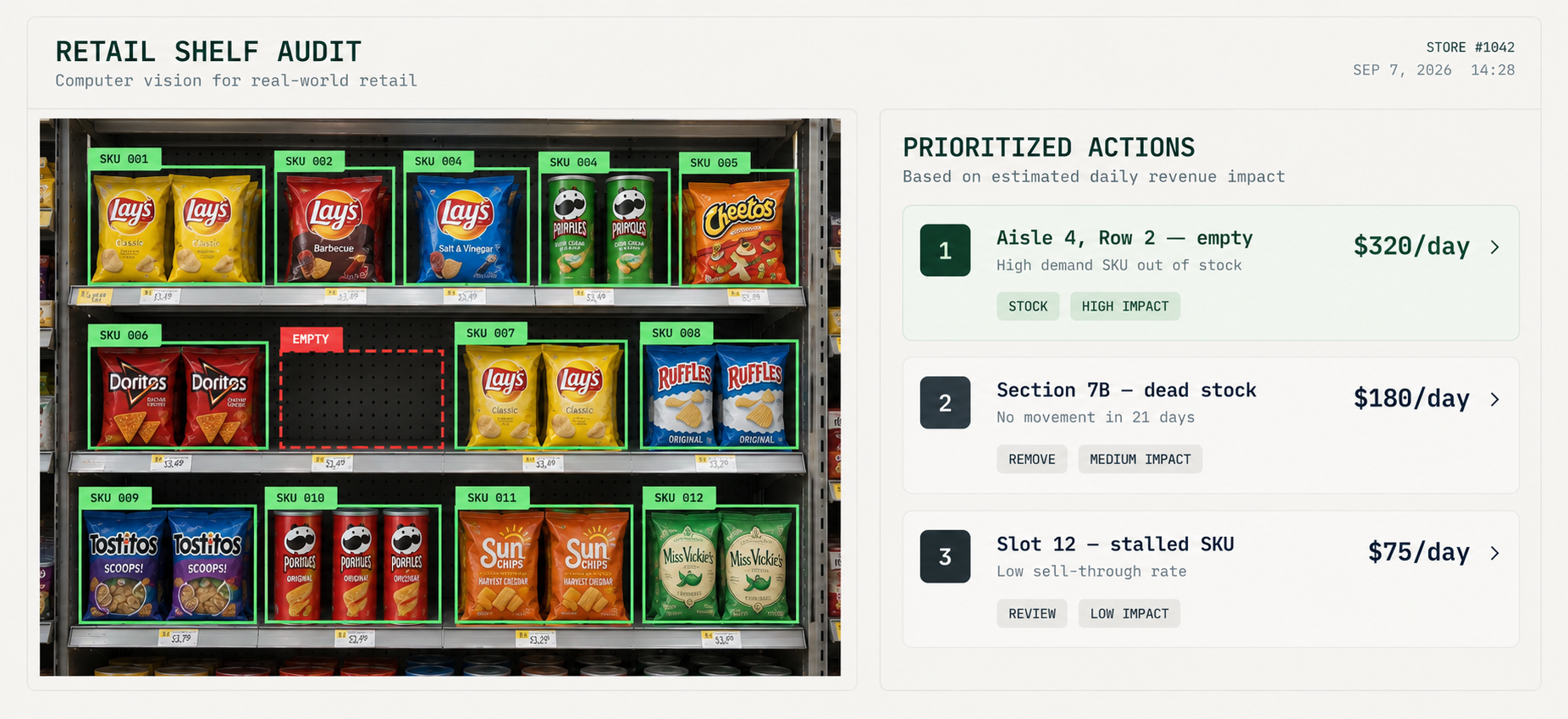
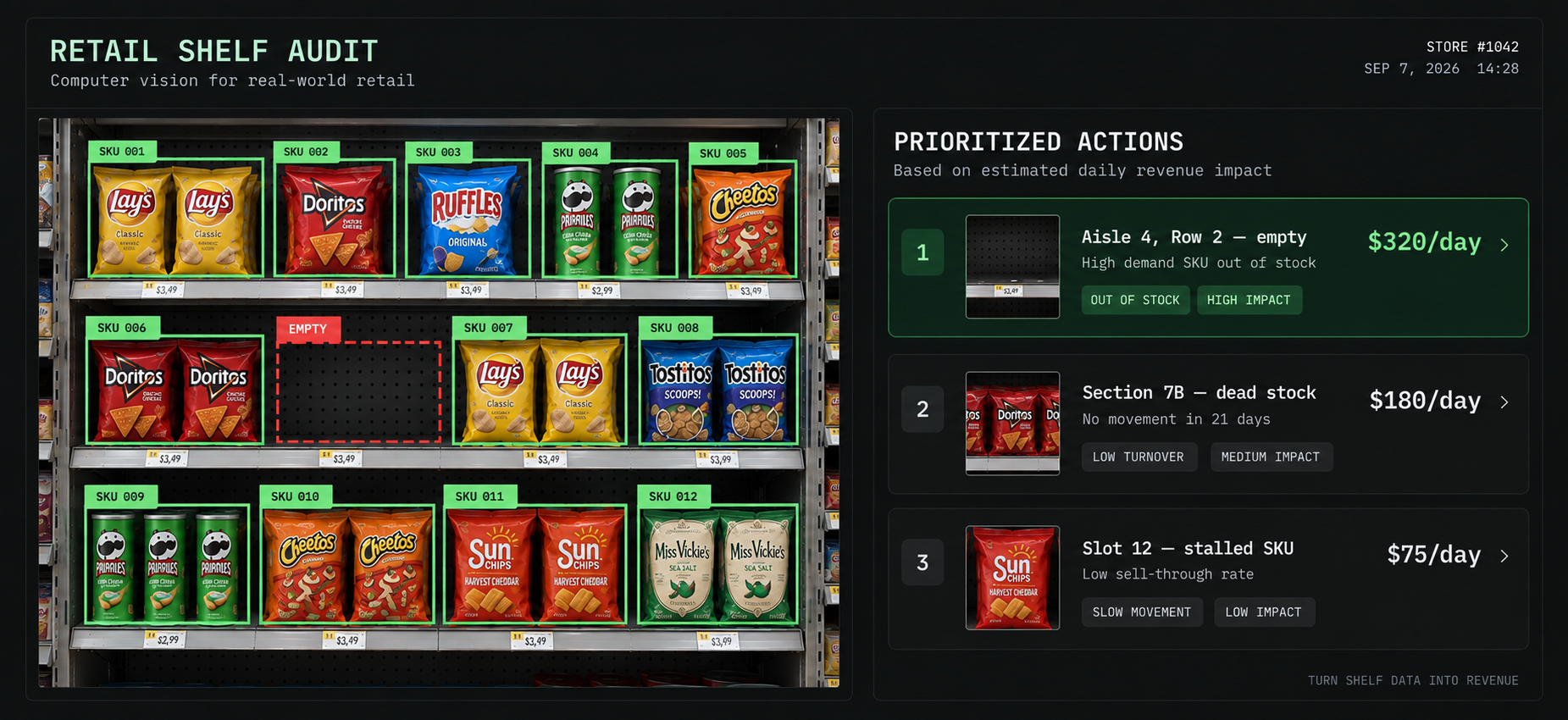
The output is not a compliance report. It is a prioritized intervention list, ranked by estimated revenue impact, generated by correlating the visual shelf state with live POS sales velocity. The shelves costing you the most revenue right now surface first. The rest follows in order.
What It Detects
Shelf-1 runs four detection tasks in parallel on each image.
Product facing detection. Every SKU visible in the shelf photo is identified, assigned a category label, and scored with a confidence value. The model handles crowded shelves, partial occlusion, and varying ambient light conditions. Accuracy figures will be published after held-out evaluation.
Price tag detection. The displayed price for each facing is extracted from the image. Retail price tags vary widely: shelf edge strips, hanging tags, printed labels, digital displays, and handwritten signs all appear in the training distribution. The price detection head is designed to cover 40+ distinct tag formats across grocery, consumer goods, and specialty retail categories. Tags that are occluded, missing, or unreadable are flagged separately in the output.
Inventory estimation. Shelf-1 counts the number of units visible per facing and identifies empty or near-empty slots. Empty slot detection distinguishes between a slot that has sold out, a slot that has not been restocked, and a slot that has never been stocked in this audit cycle. Each condition produces a different recommended action.
Planogram deviation detection. When a planogram is on file for the scanned section, Shelf-1 compares the detected shelf state against the expected product layout. Misplaced facings, wrong-category products, and unauthorized substitutions are all flagged with position-level specificity.
The Output
Every Shelf-1 scan produces a single prioritized action list. Items are ranked by estimated revenue impact, calculated by pairing the visual shelf state with live sales velocity from the client’s POS system.
A slot selling 40 units per day that has gone empty ranks higher than a slot selling 4 units per week that has gone empty. A premium facing position occupied by a slow-moving SKU ranks above a mid-shelf deviation that has no material effect on sales. The ranking is done in real time, using actual velocity data, not category averages.
The action list is structured for the store associate doing the next restock: go to aisle 4, row 3, position 2 first. That is the highest-impact intervention available right now. The list continues in order from there.
Technical Specifications
- Inference time
- Target: under 90 seconds per photo on standard client hardware
- Deployment
- On-premises only. No data leaves the store network at any point in the pipeline.
- Hardware
- Runs on standard workstation-class hardware. No GPU required for inference.
- Input
- Standard smartphone photos from iOS or Android. No specialized capture device required.
- POS integration
- Direct integration with major POS systems via standard API. Shelf visual data is correlated with sales velocity in real time to produce revenue-ranked output.
- Model ownership
- Clients own the deployed model weights. No per-call licensing fees. No ongoing API dependency.
- Training data
- Planned training on annotated shelf images across grocery, consumer goods, and specialty retail formats. Price detection targets 40+ distinct tag formats.
Pilot Process
We run a structured three-stage process. No commitment is required until after Stage 2.
Stage 1: Live demonstration. A 30-minute session using your own shelf photos. Bring images from any category or store format in your network. We run Shelf-1 against them in real time so you can evaluate output quality before anything else.
Stage 2: Limited-store pilot. A 4 to 6 week deployment in a subset of your stores, running against your own inventory data and POS system. The pilot is structured to produce a clear before-and-after signal on intervention response time and restocking accuracy so the business case is measurable before full rollout.
Stage 3: Full deployment. On-premises installation across the full store network, staff training, and ongoing support. Because the model runs locally and clients own the weights, there is no external dependency to manage after deployment.
Get Started
To request a Stage 1 demonstration or ask questions about fit for your store format, contact us at founders@generalmachines.ai.
Include a brief description of your store format and the specific shelf analytics problem you are trying to solve. We will respond within two business days.